

When you turn on your kitchen tap in Malta, you want complete confidence that the water filling your glass is clean, fresh, and safe for your family. In recent years, growing global awareness surrounding chemical contaminants—specifically per- and polyfluoroalkyl substances, commonly known as PFAS or "forever chemicals"—has led many local residents to ask an important question: Can a home water filter actually remove PFAS from tap water in Malta? This article is written for Maltese households who want clean, great-tasting tap water without relying on heavy plastic bottle crates or worrying about unseen micro-contaminants. You will discover exactly how PFAS enters water sources, what scientific research shows about Malta’s tap water, and how an under-sink system like the Tappwater InlinePro SMR® reliably filters out contaminants while retaining essential minerals.
Key Takeaways
- PFAS Reality in Malta: A 2019 study by the University of Malta found detectable levels of PFAS in 100% of tested groundwater boreholes, whereas treated Reverse Osmosis (RO) desalinated public water showed no detectable PFAS.
- Local Tap Water Blend: Public tap water in Malta is currently a blend of approximately 70% Reverse Osmosis desalinated seawater and 30% groundwater, meaning trace contamination from PFAS could occur depending on local supply ratios.
- Effective Multi-Stage Filtration: Advanced multi-stage filtration featuring high-density Carbon Fibre Mesh and nanofiltration reduces PFAS contaminants by up to 93%+ while removing over 100 other impurities.
- Mineral Balance Preserved: Unlike traditional under-sink systems that strip water completely bare, Swedish Mineral Rock™ (SMR) technology ensures healthy calcium, magnesium, and potassium remain for optimal taste and hydration.
- Under-Sink Convenience & Value: The Tappwater InlinePro SMR® connects directly to standard cold-water lines in minutes with basic DIY setup, delivering 8–10 L/min flow without cluttering your countertop, saving local families over €200 every year over single-use bottled water.
Table of Contents
What Are PFAS "Forever Chemicals" and Why Are They in Water?
Per- and polyfluoroalkyl substances (PFAS) are a group of thousands of synthetic chemicals used since the 1940s in commercial products worldwide. Thanks to their exceptional ability to resist heat, oil, grease, and water, PFAS found their way into non-stick cookware, stain-resistant fabrics, water-repellent clothing, firefighting foams, and food packaging.
The chemical bond between carbon and fluorine atoms in PFAS is one of the strongest in chemistry. Because of this bond, these substances do not break down naturally in the environment—earning them the universal nickname "forever chemicals." Over decades, industrial runoff, landfill waste, and firefighting activities allow PFAS to seep into soil and underground water aquifers. Health agencies and researchers associate long-term exposure to certain PFAS compounds with potential health concerns, making effective water filtration at home an increasingly popular choice for safety-conscious households.
Is PFAS a Concern for Tap Water in Malta?
To understand whether PFAS is present in your kitchen tap water in Malta, it helps to understand where local tap water originates. The Water Services Corporation (WSC) supplies public tap water across Malta and Gozo using a blended system that combines two distinct water sources:
- Reverse Osmosis (RO) Desalinated Seawater: Produced at state-of-the-art coastal desalination plants, making up approximately 70% of Malta's public tap water supply.
- Groundwater Extraction: Pumped from underground aquifers via deep boreholes across the islands, supplying around 30% of public tap water.
Scientific research provides clear insight into these two sources. A 2019 study conducted by the University of Malta tested sampled groundwater boreholes across the islands and revealed that 100% of tested groundwater boreholes contained detectable levels of PFAS, with perfluorooctanoic acid (PFOA) as the dominant contaminant at concentrations up to 2.68 ng/L. Conversely, treated Reverse Osmosis desalinated water showed no signs or quantifiable amounts of PFAS.
Because tap water supplied to Maltese homes is currently a blend of 70% Reverse Osmosis water and 30% groundwater, trace contamination of PFAS can potentially occur depending on local distribution and seasonal blending ratios. Installing a dedicated multi-stage home water filter provides an immediate, reliable final barrier right at your kitchen tap.
Which Water Filters Can Actually Remove PFAS Contaminants?
Not all water filtration methods offer equal protection against microscopic synthetic molecules. Simple pitcher filters or basic single-mesh strainers often lack the physical density or contact time required to capture dissolved chemical compounds like PFAS.
To effectively trap microscopic PFAS molecules and heavy metals, a filter must utilize advanced physical adsorption and multi-stage media. The main filtration options compare as follows:
| Filtration Technology | PFAS Reduction Capacity | Key Characteristics & Trade-offs |
|---|---|---|
| Basic Pitcher Filters | Low to Moderate | Slow gravity flow, limited media volume, frequent replacement needs. |
| Dual Carbon Fibre Mesh & Nanofiltration | Up to 93%+ Reduction | High absorption surface area, retains healthy minerals, strong flow rate (8–10 L/min). No water wastage. |
| Reverse Osmosis | Up to 99%+ Reduction | Complete filtration, but strips all beneficial minerals and generates wastewater and uses power. |
Advanced Carbon Fibre Mesh technology provides a vast surface area with high adsorption capacity. As water flows through the fine fiber network, PFAS molecules, chlorine, and organic compounds adhere tightly to the filter media while allowing healthy water molecules to flow freely.
Meet the Tappwater InlinePro SMR®: Your Under-Sink Shield Against Contaminants
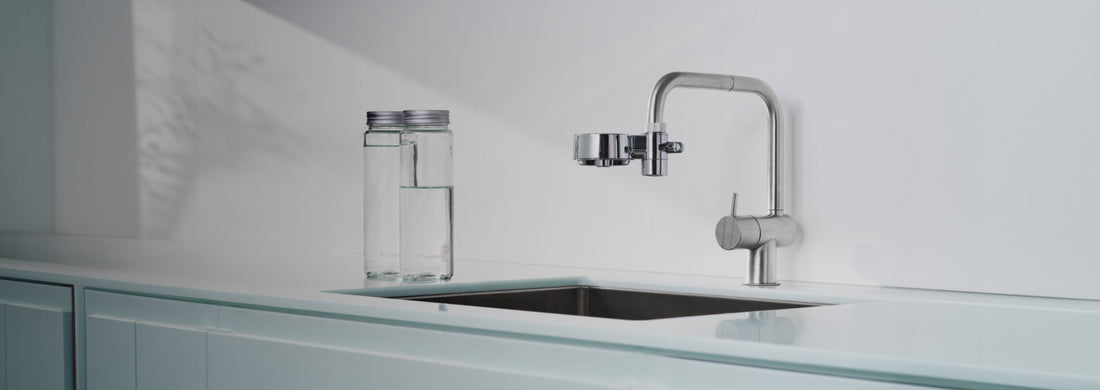
If you want robust filtration without sacrificing kitchen counter space or tap pressure, the Tappwater InlinePro SMR® is built specifically for modern households. Installed neatly inside your under-sink cupboard, this system connects directly to your standard cold-water line, delivering pure, refreshing water straight from your existing kitchen tap.
The 5-stage filtration system inside the InlinePro SMR® protects your water through a targeted design:
- Precision Pre-Filter Mesh: Traps physical particles, sediment, rust, and micro-debris commonly found in municipal distribution pipes.
- Carbon Fibre Mesh Adsorbstion Layer: Adsorbs up to 93% of PFAS forever chemicals, 95% of chlorine, heavy metals, pesticides, and organochlorine compounds, eliminating chemical aftertastes.
- Carbon Fibre Mesh Mechanical Filtration Layer: Membrane filtration for filtration of organic
- Swedish Mineral Rock™ (SMR) Technology: Enriches filtered water with essential Calcium, Magnesium, and Potassium, optimizing pH and creating a clean, crisp, natural taste.
- Fine Metallic Finish Mesh: Ensures final particle containment and smooth, steady water flow.
- Final Micro-Filtration Barrier: Guarantees clean, clear, microplastic-free drinking water every time you turn on your tap.
Despite its compact, square flat-base housing that requires no wall mounting, the InlinePro SMR® delivers an exceptional flow rate of 8–10 liters per minute with minimal pressure loss. This makes it effortless to fill large cooking pots, wash fresh produce, or fill water bottles instantly.
As user Pamela K shared after installing her unit:
"The water tasted very good. The system is extremely discreet and doesn't take up much space in the cupboard. Also there's no need to change your tap. I am very pleased with it"
Similarly, Charmaine T. highlighted how seamlessly the filter fits into daily kitchen life:
"I'm loving my InlinePro filter - the water tastes great, and the filter is very user-friendly and doesn't take up much space at all. So happy I installed it."
Say Goodbye to Heavy Water Packs and BCRS Queues in Malta
Beyond safety and superior taste, switching to an under-sink filter transforms your daily household routine. Maltese residents know all too well the physical burden of buying plastic bottled water: lugging heavy 6-pack water crates up flights of stairs, storing bulky plastic bottles in small kitchens, and sorting empty plastic for local BCRS reverse vending machines.
Making the switch to Tappwater offers immediate practical benefits:
- Save Over €200 Annually: Buying plastic bottled water for a family of three costs upwards of €250–€300 per year. Tappwater research shows the average family saves €236 per year after changing to Tappwater. An InlinePro SMR® cartridge lasts up to 15,000–20,000 liters (up to 12 months for 1–3 person households), costing a fraction of bottled water.
- Eliminate Plastic Waste: Tappwater Malta research shows that the average family avoids the use of 600 plastic bottles per year when switching to Tappwater, keeping kilograms of single-use plastic out of local waste streams.
- Easy DIY Installation: There is no need for a plumber or a new kitchen mixer tap. The included universal installation kit with quick-connect fittings hooks straight up to standard cold-water pipes in minutes.
With over 9,100 households in Malta already trusting Tappwater and 95% of customers keeping their Tappwater filter after our 45-day trial period, taking control of your home’s drinking water safety is simple, affordable, and rewarding.
Reference: University of Malta 2019 study on PFAS in groundwater boreholes (Godwin Sammut et al., https://www.um.edu.mt/library/oar/bitstream/123456789/73180/1/Godwin%20Sammut.pdf
Frequently Asked Questions
-
What are PFAS and why are they called "forever chemicals"?
PFAS (per- and polyfluoroalkyl substances) are synthetic chemicals used in non-stick coatings and industrial products. They are called "forever chemicals" because their extremely strong carbon-fluorine bonds prevent them from breaking down naturally in the environment or the human body. -
Is PFAS contamination possible in Malta's public tap water?
Yes. A 2019 study by the University of Malta detected PFAS in 100% of sampled groundwater boreholes, whereas Reverse Osmosis desalinated water contained none. Because Malta's tap water is a blend of 70% Reverse Osmosis water and 30% groundwater, trace PFAS contamination can occur, making home filtration a reliable barrier. -
Can a water filter remove PFAS from tap water in Malta?
Yes. Filters equipped with high-density Carbon Fibre Mesh, such as the Tappwater InlinePro SMR®, effectively adsorb synthetic chemical molecules and reduce PFAS compounds by up to 93%+. -
Does the InlinePro SMR® strip healthy minerals from tap water?
No. Unlike full reverse osmosis units that strip water completely, the InlinePro SMR® uses Swedish Mineral Rock™ (SMR) technology to retain and enrich beneficial minerals like Calcium, Magnesium, and Potassium for optimal taste and health. -
Will installing an under-sink water filter reduce my kitchen tap pressure?
No. The InlinePro SMR® is engineered for high flow rates of 8–10 liters per minute, maintaining strong tap pressure so you can fill pots and glasses instantly without delay. -
How hard is it to install the InlinePro SMR® in a Maltese kitchen?
Installation is straightforward DIY with no plumber or new tap required. The unit features a compact, flat base that sits in your under-sink cabinet and connects directly to standard cold-water lines using quick-connect fittings. -
How much money can a Maltese family save with an under-sink water filter?
Tappwater research shows that the average family in Malta saves €236 per year and eliminates 600 single-use plastic bottles by replacing bottled water with a Tappwater system.


![[WATCH] Tappwater Tales #1: The importance of water quality for horses in Malta](http://tappwater.mt/cdn/shop/articles/20260804.BalanceEQ_a4a7d1fe-e264-409a-b1ca-9410c7aadefc.png?v=1785829811&width=1080)



![[WATCH] Malta's Tap Water Challenge: The Tappwater Solution. A Look at the Science, the Tests, and the Deliciously Clean Results.](http://tappwater.mt/cdn/shop/articles/Why_We_lab_tested_maltas_water_Sqaure.png?v=1756738451&width=1080)


0 comments